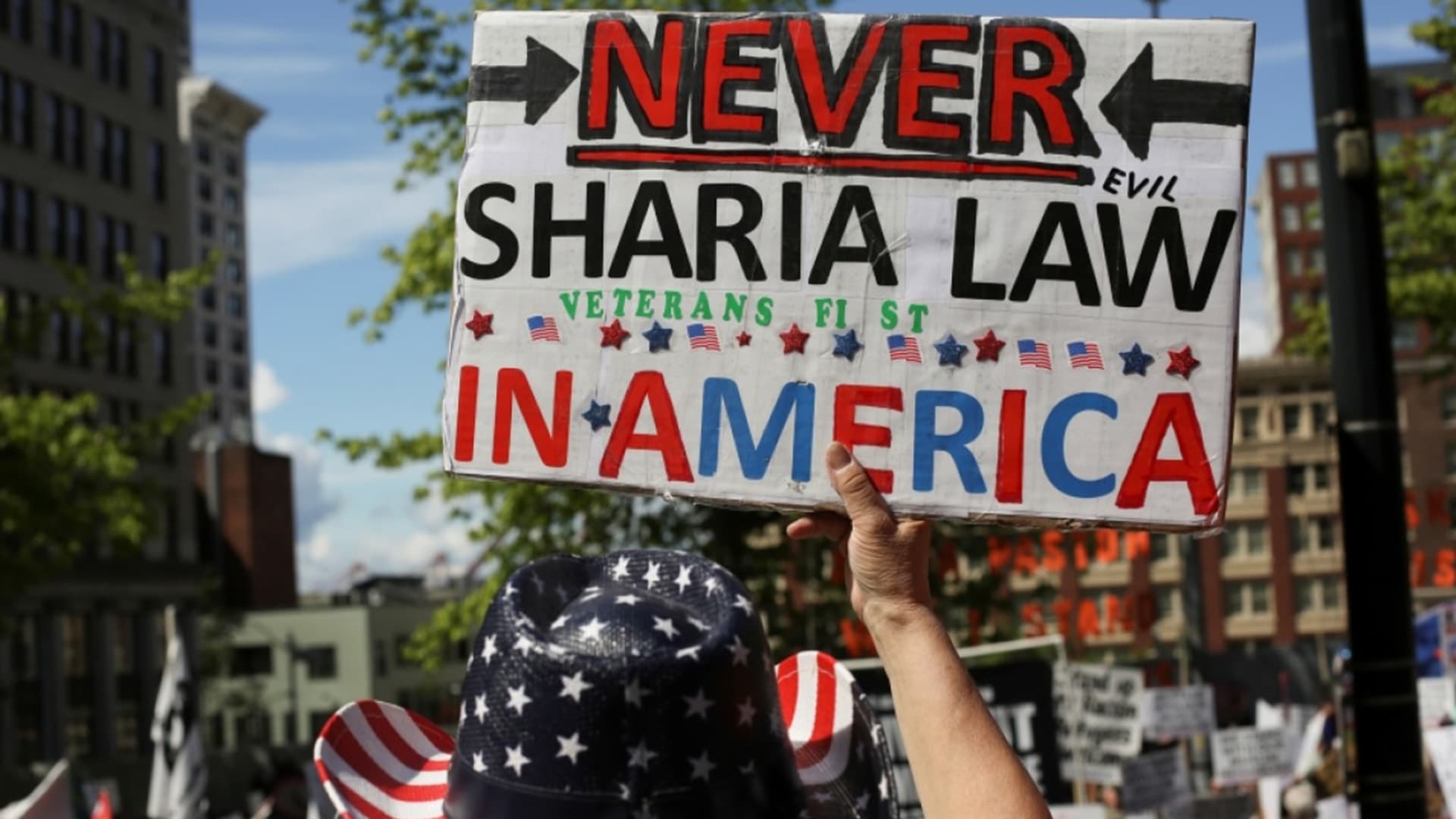
Do Muslims want to impose Sharia law in the West?
Few accusations appear more frequently in discussions about Islam in Western societies than the claim that Muslims ultimately seek to impose Sharia law. The fear is not merely that Muslims wish to practice their religion privately, but that they harbor a long-term political ambition to replace secular law with Islamic law and compel others to live under it.
Few accusations appear more frequently in discussions about Islam in Western societies than the claim that Muslims ultimately seek to impose Sharia law. The fear is not merely that Muslims wish to practice their religion privately, but that they harbor a long-term political ambition to replace secular law with Islamic law and compel others to live under it.
Answering this question requires moving beyond speculation about motives. Two kinds of evidence are necessary: what Islamic law actually teaches about political authority, and what Muslims themselves say they want in the societies where they live.
When examined through both lenses, the claim that Muslims in the West seek to impose Sharia becomes difficult to sustain.
What Sharia actually governs
Public discussion often treats Sharia as if it were primarily a criminal code waiting to be enforced. In reality, the overwhelming majority of Islamic law concerns matters of personal ethics and communal life: prayer, fasting, charity, marriage, inheritance, dietary practice, and commercial conduct. Classical jurists developed extensive legal literature regulating contracts, charitable endowments, family responsibilities, and ritual observance.
This does not mean that Sharia contains no criminal law. It does. But even historically, criminal punishments represented only a small portion of the legal tradition, were subject to stringent evidentiary standards, and—crucially—were understood to require legitimate political authority to implement. Islamic law does not permit individuals or communities acting on their own to enforce criminal punishments. These were matters tied to governance, judicial procedure, and public order, not private initiative.
This distinction matters in the modern Western context. Muslims living as minorities do not possess sovereign authority, nor do classical or contemporary scholars argue that they should attempt to exercise it.
Rather, a widely recognized principle within Islamic jurisprudence is that Muslims living in non-Muslim societies are bound by the laws of the land so long as they are able to practice their religion. This includes respecting the criminal law of the state and utilizing its legal institutions when necessary.
It is also important to note that even in classical Islamic governance, the application of criminal law was not indiscriminate across populations. Non-Muslims living under Muslim rule were generally governed by their own communal laws in matters of personal status, and the enforcement of Islamic criminal law was tied to specific legal and political frameworks rather than applied universally in the abstract.
As the legal historian Wael Hallaq observes, the central activity of Islamic law was not penal enforcement but the regulation of everyday moral and social life. When Sharia is understood in its full scope—as a moral-legal system rooted primarily in personal conduct and communal ethics—the idea that it is poised for unilateral imposition through coercive enforcement becomes far less plausible.
Islamic law and Muslims living under non-Muslim rule
A second assumption behind the imposition narrative is that Islamic doctrine requires Muslims to dominate politically, wherever they live. Classical Islamic jurisprudence, however, contains extensive discussions about Muslims living under non-Muslim authority.
Historically, Muslim jurists addressed situations in which Muslims resided in territories governed by non-Muslim rulers through trade, treaty arrangements, or minority status. These discussions recognized that Muslims might live under political systems not governed by Islamic law while continuing to practice their religion and maintain communal life.
Modern Muslim scholars have expanded upon these precedents to articulate frameworks for Muslim citizenship in non-Muslim societies. The prominent jurist Yusuf al-Qaradawi, for example, argued that Muslims living in Western democracies may fully participate in civic life and abide by the laws of the state so long as they retain the freedom to practice their religion.
This strand of jurisprudence does not treat minority life as an aberration requiring eventual domination. Rather, it recognizes political pluralism as a practical and legitimate condition.
What Muslims in the West actually say
Beyond doctrine, the empirical record is equally revealing. Large-scale surveys of Muslim attitudes consistently show that Western Muslims prioritize religious freedom and civic participation rather than the establishment of Islamic law as state law.
One of the most comprehensive datasets comes from Pew Research Center, which surveyed tens of thousands of Muslims across dozens of countries. The study found that even in countries where many Muslims say Sharia should play a role in public life, the majority believe it should apply only to Muslims, not to non-Muslims.
Among Muslims living in Europe and North America, support for replacing secular law with religious law is significantly lower. Instead, respondents consistently emphasize religious freedom, economic opportunity, and civic equality as their primary concerns.
In other words,
Muslims who express support for Sharia often mean something quite different from what critics imagine: the ability to live according to their religious norms in matters such as family life, charity, and personal conduct, rather than the establishment of a theocratic state.
Advocacy is not imposition
Even when Muslims advocate for policies informed by their religious values, this does not constitute imposition. Democratic societies function through competing moral visions expressed through political participation. Religious citizens of many traditions advocate laws shaped by their moral convictions—whether on issues such as abortion, environmental policy, or social welfare.
Muslims participating in public debate do not exercise state power simply by arguing for their values. The distinction between persuasion and coercion is fundamental to constitutional democracy.
Classical Islamic scholarship also recognized this distinction. Jurists such as Al-Ghazali emphasized that moral accountability depends on intention and volition, not merely outward compliance. A law obeyed only under compulsion does not produce genuine moral responsibility.
For that reason, Islamic legal discourse has long grappled with the limits of coercion and the importance of voluntary adherence in matters of faith.
What Muslims in western societies actually seek
Taken together, doctrinal and empirical evidence point to a far more modest set of aspirations than critics imagine.
Muslims in Western societies seek the same liberties other religious communities seek: the freedom to worship, to structure family life according to religious principles, to conduct business ethically, and to contribute to public life as equal citizens.
These aspirations do not require the replacement of constitutional law. They require the protection of religious freedom within it.
What Muslims seek is not the imposition of a parallel legal order, but the freedom to live according to their moral tradition within the constitutional frameworks of the societies they inhabit.
The fear of Sharia imposition, therefore, tells us less about Muslim intentions than about persistent misunderstandings of what Sharia actually is.
Wael Hallaq, Shari'a: Theory, Practice, Transformations. Cambridge University Press, 2009.
Yusuf al-Qaradawi, Fiqh of Muslim Minorities, 2001.
Mark Cohen, Under Crescent and Cross.
Khaled Abou El Fadl, Reasoning with God, Rowman & Littlefield, 2014.
Pew Research Center, The World’s Muslims: Religion, Politics and Society, 2013.
Pew Research Center, Muslims in Western Europe, 2017.
Al-Ghazali, Ihya Ulum al-Din, discussions on intention (niyyah).